

Vox pop vs influencer
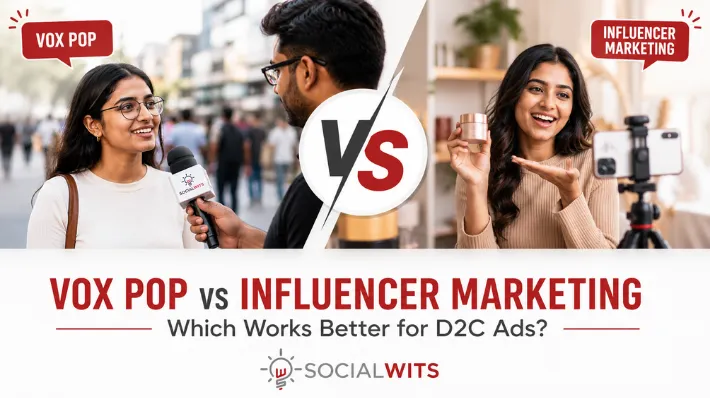
Vox Pop vs Influencer Marketing: Which Works Better for D2C Ads?
Most D2C brands default to influencer marketing when they need “authentic” content. It’s the obvious playbook – and it works. But it’s not the only way to get real, trust-building content into your ad account, and it isn’t always the most efficient one. Vox pop content is the quieter alternative that a growing number of performance-focused brands are testing, often with better cost-per-result.
Here’s an honest comparison of both, so you know which one actually fits what you’re trying to do.
What Each Format Actually Is
Influencer marketing: a creator with an existing audience produces content featuring your product, usually leaning on their personal brand, aesthetic, and follower trust.
Vox pop content: everyday people, usually with no following at all, react on-camera to a product or question in a street-interview format. There’s no personal brand being borrowed – the value comes from the reaction being unscripted and relatable.
Cost Comparison
Influencer costs scale with follower count, engagement rate, and negotiation – a single mid-tier creator collaboration can run anywhere from a few thousand to several lakh rupees, and results vary widely creator to creator.
Vox pop is typically shot in bulk – one shoot day can produce 15-20+ street interactions, which get edited into dozens of ad variants. The cost is tied to production, not to an individual’s audience size, which usually makes the cost-per-creative-asset significantly lower.
Authenticity – Which One Actually Reads as “Real”
This is where the comparison gets interesting. Audiences are increasingly aware that influencer content is paid – even when it’s disclosed as such, there’s an inherent skepticism (“of course they like it, they were paid to say that”).
Vox pop content sidesteps this almost entirely. A stranger on the street with no channel, no bio, and no obvious incentive to promote a product reads as far more neutral – which is exactly why it tends to earn stronger trust signals from cold audiences seeing your ad for the first time.
Which One Wins on Ad Performance
For top-of-funnel Meta and Google Ads campaigns targeting cold audiences, vox pop content frequently outperforms polished influencer content on:
– Hook rate (first 3-second retention) – the “man on the street with a mic” visual format is instantly recognizable and stops the scroll
– CTR – unscripted reactions create curiosity that scripted influencer lines rarely match
– Cost per creative asset – one shoot generates far more testable variations than a single influencer deliverable
Influencer content still wins when the goal is audience borrowing (reaching a creator’s specific niche following) or when a product needs a credible, expert-style endorsement (skincare routines, tech reviews, fitness).
The Smart Move: Use Both, Differently
The brands getting the best ROI aren’t choosing one over the other – they’re using each for what it does best:
– Vox pop for top-of-funnel cold traffic, creative testing, and CTR/CPA optimization
– Influencer content for niche audience reach, credibility-building, and retargeting warm audiences who already know the creator
If your ad account is starved for fresh, testable creative and your CPAs are creeping up, vox pop is usually the faster, cheaper lever to pull first.
FAQ
Q: Is vox pop cheaper than influencer marketing?
A: Generally yes, per creative asset – a single vox pop shoot produces many usable ad variants, while influencer costs scale per creator and per deliverable.
Q: Can vox pop content be used alongside influencer marketing?
A: Yes, they serve different funnel stages and combine well – vox pop for cold-audience testing, influencer content for niche reach and retargeting.
Need Fresh, Budget-Friendly Ad Creatives?
Stop relying only on influencers. SocialWits builds authentic Vox Pop campaigns that help D2C brands improve Meta & Google Ads performance.
🚀 View Service💬 WhatsApp Us